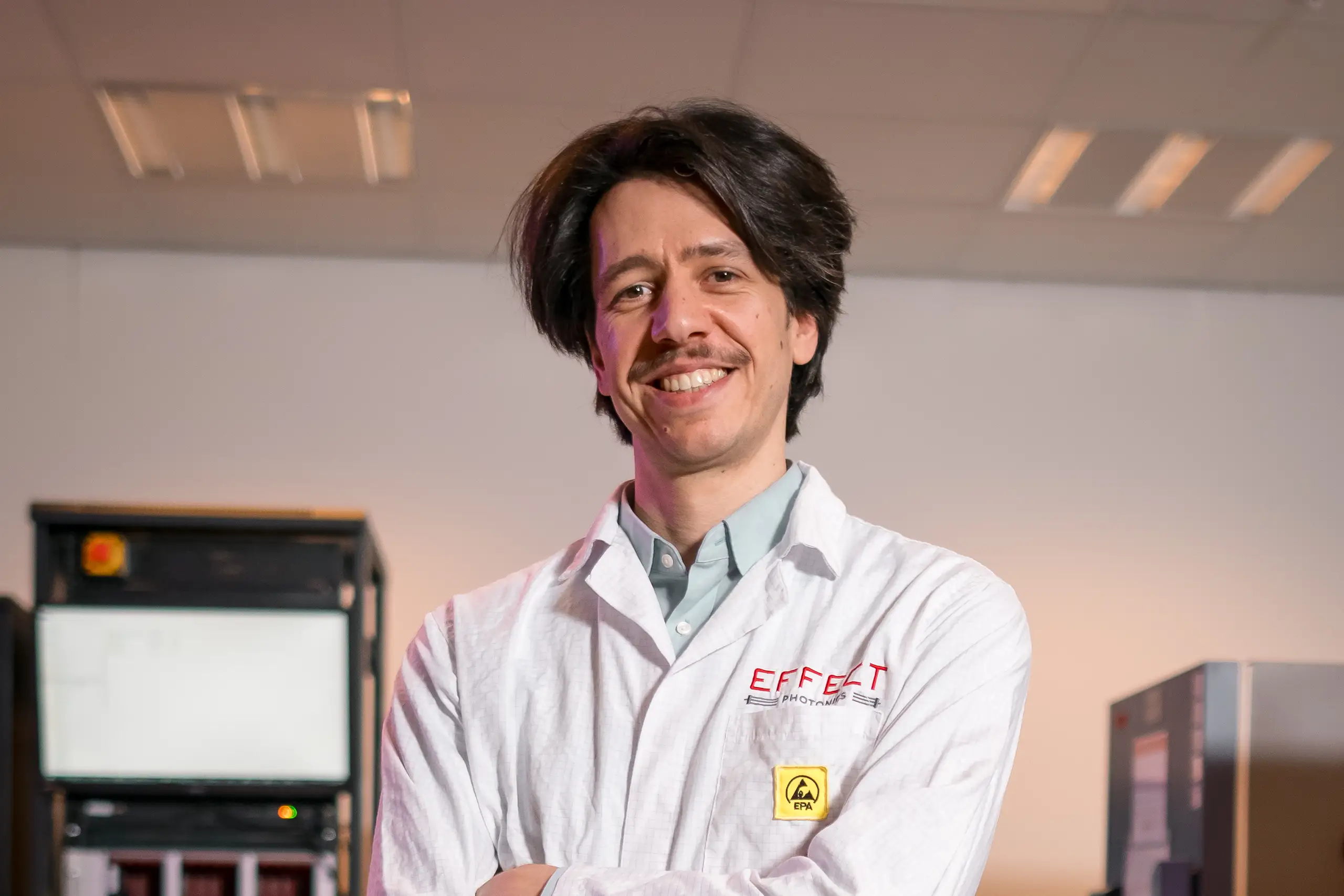
For Giuseppe Fortuna, Senior PIC Design Engineer at EFFECT Photonics, the appeal of his work comes down to one fundamental truth: communication over distance is reaching the limits of what traditional electronics can handle. Light is simply better at doing the job. “It does feel like I can contribute to discovering the potential of light,” he says. And in the rapidly growing Dutch photonics ecosystem, that potential is vast.
The power of diverse perspectives
Giuseppe’s day typically starts by getting together with his colleagues to align on the steps and goals for the day. Integrated photonics is not a field where people work in silos. His team is a mix of different cultural backgrounds and academic disciplines. “That is absolutely needed,” he explains. To innovate in this space, he notes that you have to bring together expertise from chemistry, physics, and photonics.
Once the team is aligned, Giuseppe dives into the lab. His focus is on analyzing measurement results to understand exactly how each building block behaves when interacting with electricity to produce light, and vice versa. After gathering the data, the team reconvenes to share their findings. Together, they either draw conclusions or decide to explore the data further the next day. It is a continuous, collaborative loop of testing and discovery.
Building the future of the internet
The work happening in the lab has massive real-world implications. Currently, EFFECT Photonics is developing a laser that can tune across 100 to 800 different frequencies. “That laser will probably power the internet as we know it right now,” Giuseppe notes.
But building groundbreaking technology isn’t just about getting it to work once; it’s about deep reliability. The components they are developing need to function flawlessly for ten or even more years in the field. For Giuseppe, the lab is where theory meets reality. “I verify that what we promise is actually being achieved in the lab.”
Rewriting history
What keeps Giuseppe inspired is the sheer scale of the opportunity. The technology has so much untapped potential that the daily work feels monumental. “It does feel like we’re rewriting history, like electronics did 50 years ago,” he shares.
The transition from electronics to photonics means far more than an incremental upgrade: it’s a foundational shift in how the world transmits information. For engineers like Giuseppe, showing up to work means playing a direct role in that shift. As he puts it: “This is going to become similar, and at least as impactful, as electronics is today.”