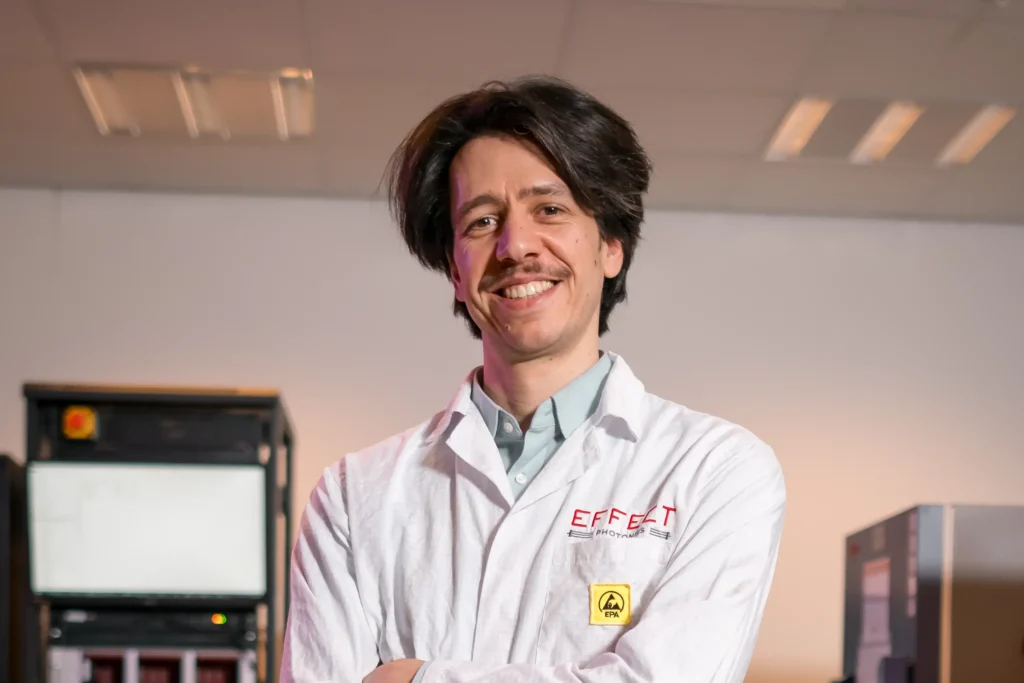
Most people working in integrated photonics will tell you the technology is extraordinary. Grace Copplestone will tell you that getting it out of the lab is the hard part. She’s the Manager for Process and Manufacturing Engineering at PHIX. Her job is to take the brilliant things photonics researchers dream up and turn them into something the world can actually use, bridging the gap between a working prototype and a product that can be manufactured at scale.
When we asked how she feels about the work, she did not reach for technical achievements. She talked about the company, and how happy she was to see where it had got to and to know she had played a part in it. “It is the mindset of someone who understands that great technology only matters if it actually reaches people”, she explains.
What it means to be the bridge
PHIX specialises in photonic packaging, taking customers’ photonic modules and preparing them for volume production. It is the often-invisible step that determines whether an innovation stays in a research paper or ends up in a product someone buys.
Grace’s team sits right at that junction. On a typical day that means checking in with her engineers, unblocking problems, and working on processes for projects not yet started. But the part she keeps coming back to is something harder to put on a job description: being the bridge between management and the company vision, connecting those things together, as she puts it. Most people are either close to the technical work or close to the strategy. Grace operates in both places at once. It is a skill that is difficult to teach and increasingly valuable as photonics companies grow.
An industry that is still being written
Ask Grace what she finds most exciting and she gives an answer that cuts straight to why this industry is worth paying attention to right now. The standards in photonics have not been set yet, she says, and that means you can really make your mark. The processes her team builds at PHIX, the quality standards they establish, the methods they pioneer for bringing photonic modules into production: these do not come from a handbook. They are being invented in real time, by the people doing the work.
Grace is honest that this can feel uncertain. But she is equally clear about why it does not worry her. With so much support from the Dutch government and the EU, she says she actually feels there is a lot of job security in the industry. And she has a point: a new photonic chip pilot line industrial-scale photonic chip factory is currently under construction in Eindhoven, backed by 153 million euros from the EU Chips Act, PhotonDelta, and the Dutch government. The infrastructure is being built deliberately and at serious scale.
The photonic chip industry does not only need chip designers
It needs the people who make sure chips become products. Want to be the first to know about new opportunities in the photonic chip industry? Leave your details to get the latest jobs, news, and events delivered straight to your inbox.